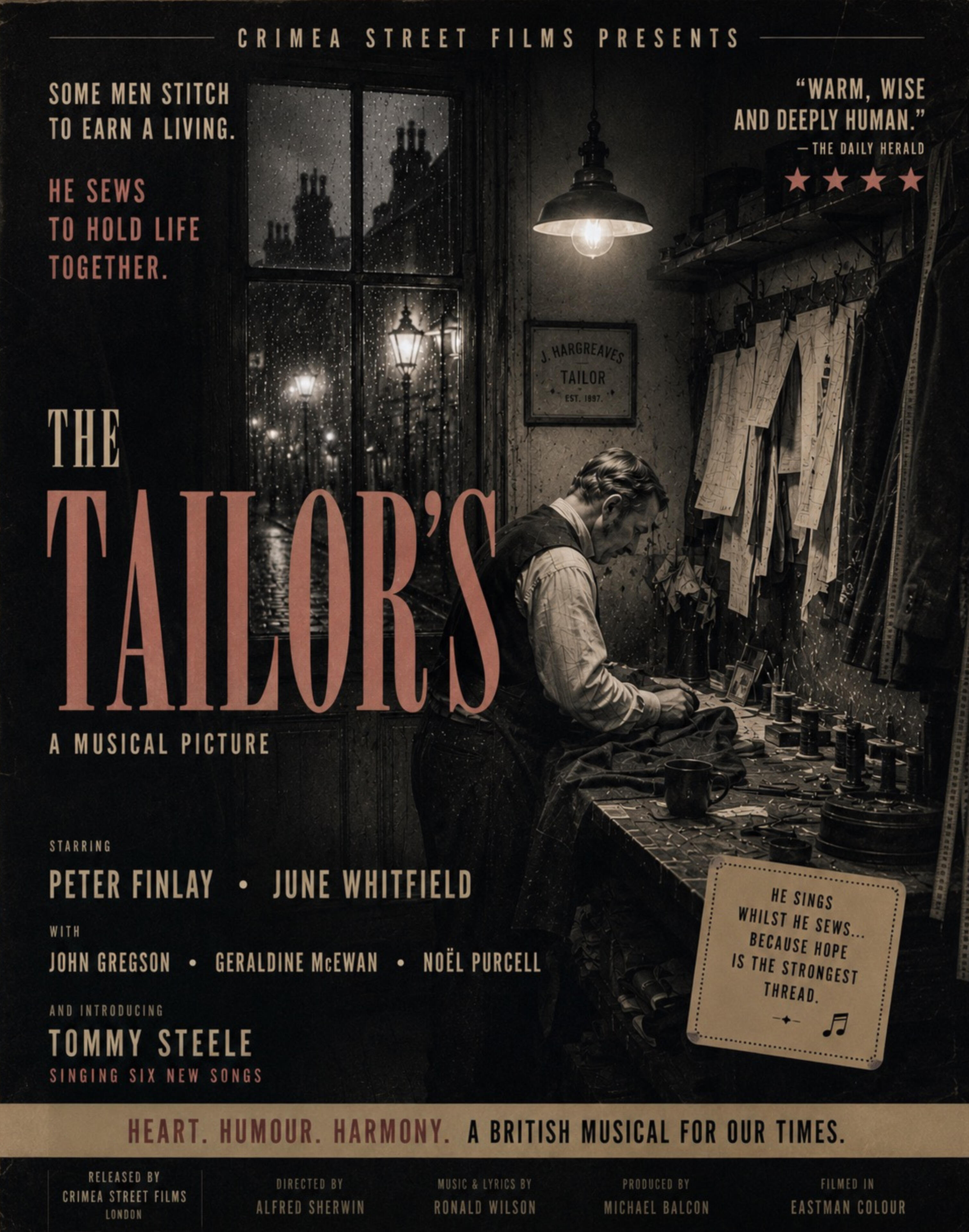
The Tailor's (1960)
some men stitch to earn a living
Released in late 1960, The Tailor’s represented Crimea Street Films’ brief and somewhat ill-advised attempt to broaden its audience through musical cinema. Though still unmistakably northern in atmosphere, the production introduced songs, moments of dry humour and a degree of emotional warmth largely absent from the studio’s earlier work.Directed by Alfred Sherwin, the film followed widowed tailor Samuel Hargreaves as he struggled to keep his small shop operating amid declining trade and changing fashions in an unnamed mill town. Between alterations, fittings and unpaid accounts, Hargreaves quietly attempted to hold together not only his business, but much of the surrounding street itself.The production became notable for casting Tommy Steele in a supporting role, reportedly at the insistence of distributors hoping to make the studio’s work more commercially accessible. Steele performed six original songs throughout the film, though several were delivered in unusually subdued fashion, including one sequence sung almost entirely while hemming trousers during a power cut.
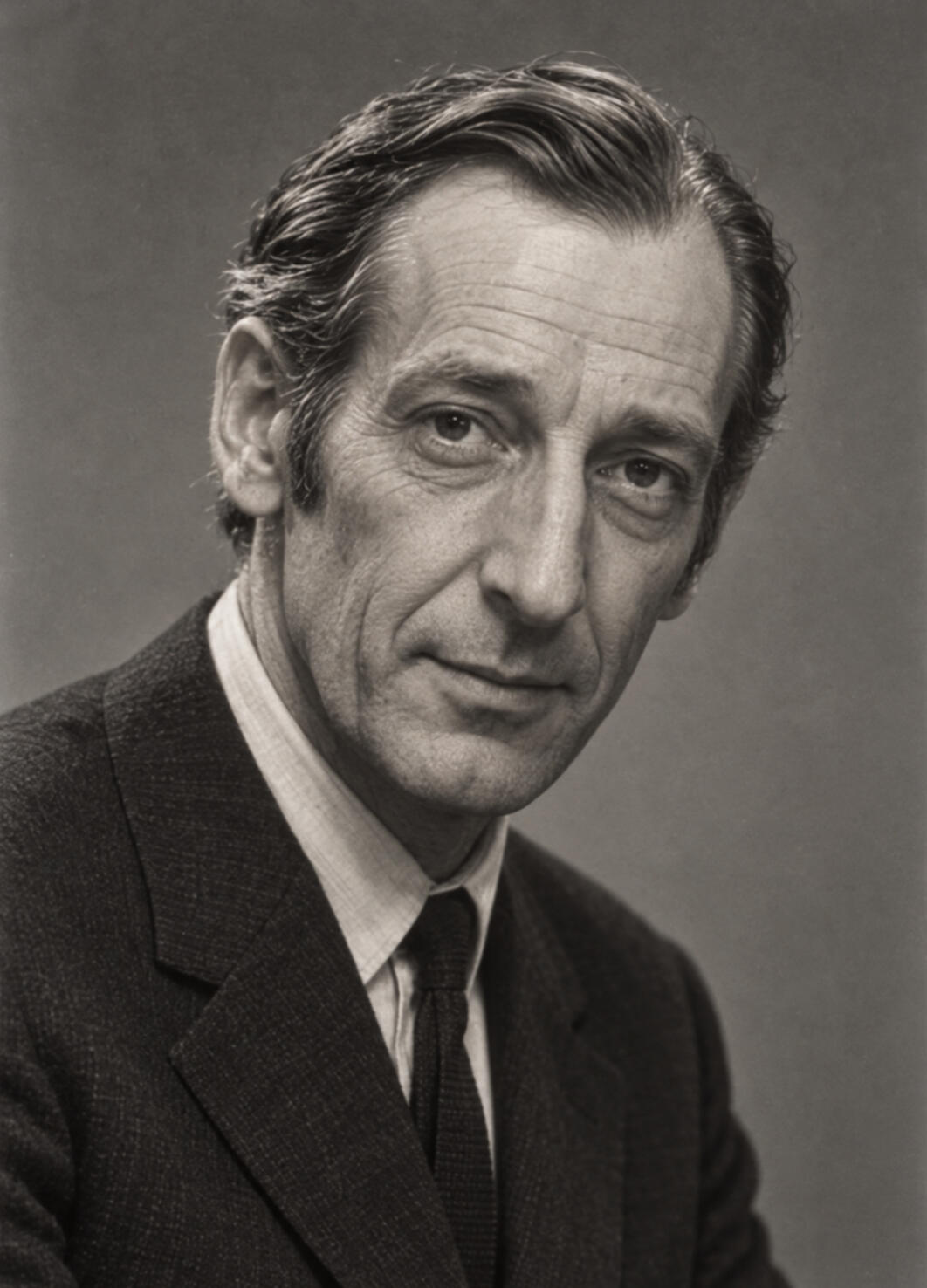
Peter Finlay (1913–1989)Born in Accrington, Peter Finlay left school at fourteen and began work as an apprentice cutter in a men’s clothing factory. He became involved with a local amateur dramatic society after volunteering to repair costumes for one of its productions and gradually moved from working behind the stage to appearing on it.Finlay spent much of the 1940s and 1950s in repertory theatre, where his narrow features, restrained manner and slightly melancholy voice made him particularly effective as clerks, craftsmen and men enduring private disappointments. He later appeared in small television roles, although he remained better known in northern theatres than nationally.In The Tailors, Finlay played Joseph Hargreaves, an ageing tailor attempting to keep his workshop open while the street around him changed beyond recognition. His own experience in the clothing trade gave his movements at the workbench an unusual authenticity. Rather than using a hand double, Finlay performed the measuring, cutting and stitching himself.Although promoted as a musical, his songs were delivered quietly while he worked, more like thoughts accidentally spoken aloud than conventional performances. Critics praised his refusal to sentimentalise the character, with one reviewer describing him as “a man holding his life together with the same care he gives a loose seam”.Finlay was an obsessive crossword solver and frequently wrote to newspaper editors disputing their clues. During a theatre run in Preston, he reportedly delayed an afternoon performance by eleven minutes because he refused to go on stage until somebody could explain why “bird in retreat” was supposed to mean “tern”.He continued working in theatre and television throughout the 1960s and 1970s, usually in supporting roles. Finlay retired in 1981 and returned to Lancashire, where he spent his later years repairing clothes for friends while insisting that he had never enjoyed sewing.He died in 1989, aged 76.
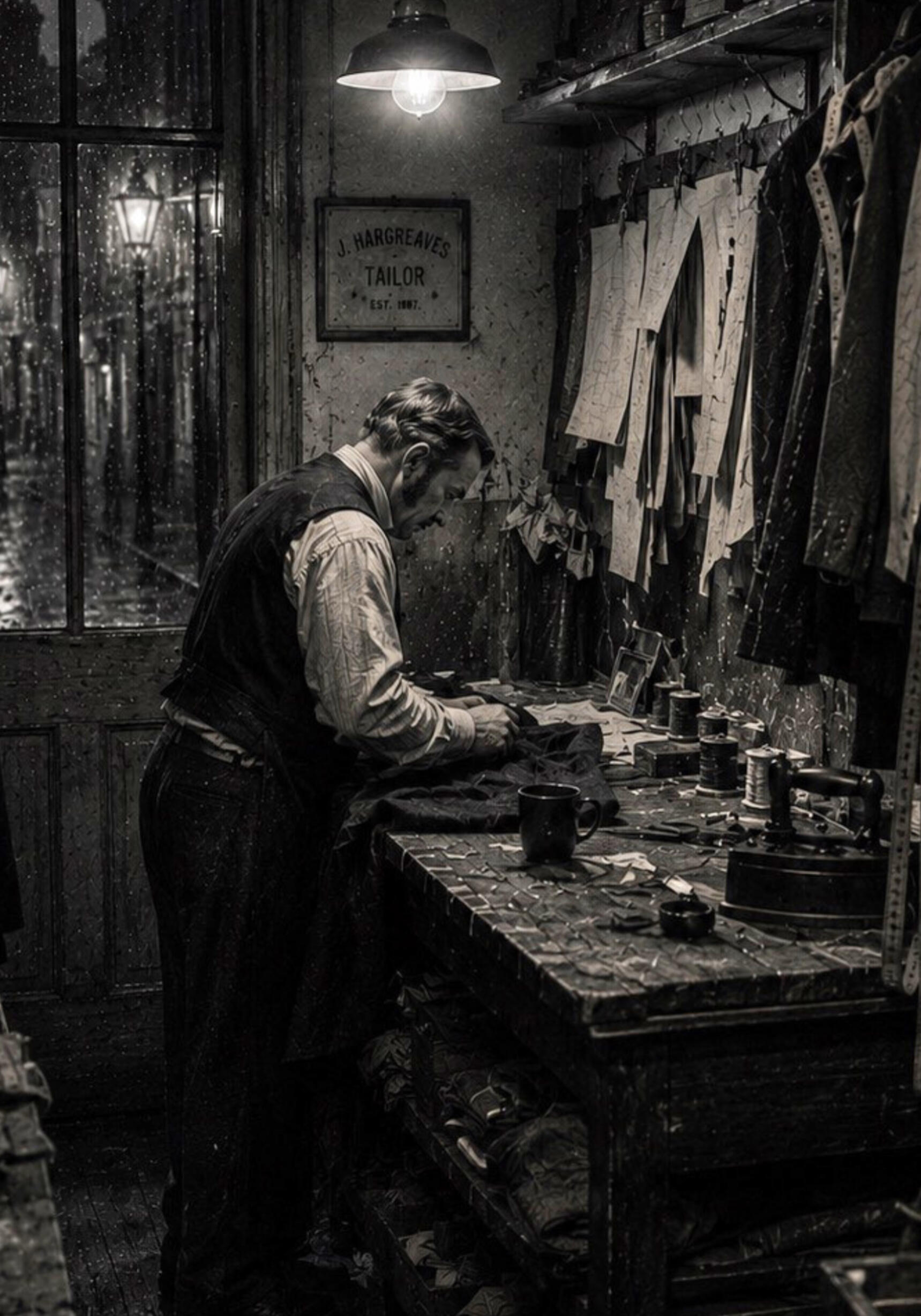
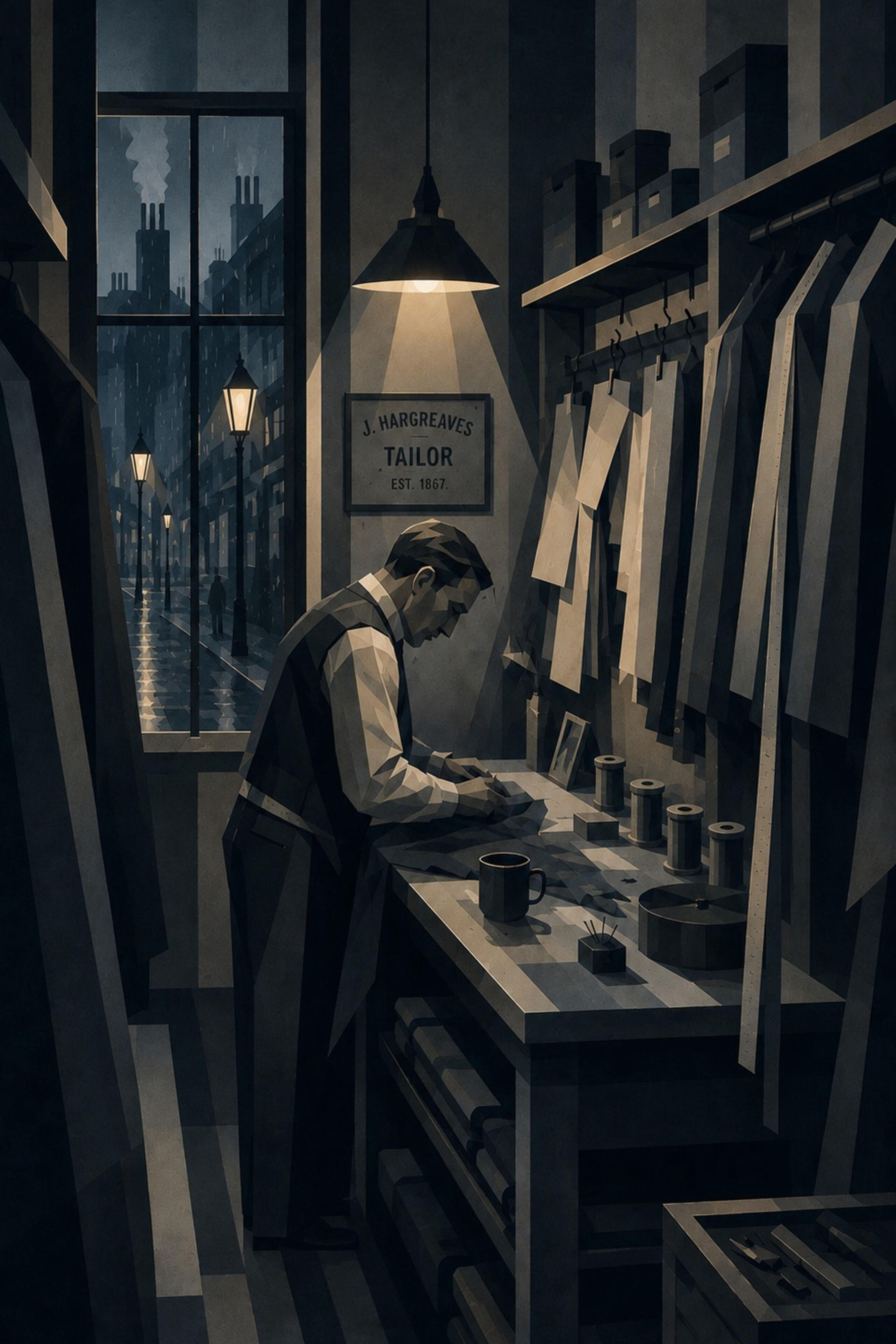
The Tailors turns a traditional workshop into a carefully ordered study of craft, concentration and geometry. Beneath the glow of a single hanging lamp, the tailor works alone among paper patterns, hanging templates, cotton reels and measuring tapes, each element reduced to strong angular forms.The close, shadowed interior is contrasted with the rain-darkened street beyond the window, where repeating lamps and terraces draw the eye deep into the northern night. A restrained palette of charcoal, slate and warm cream gives the scene a quiet intensity, while the sharply constructed shapes reflect the precision of the work itself.Part of the Northern Deco collection, The Tailors celebrates the discipline behind a well-cut garment and the anonymous hands responsible for making it.Available exclusively through FCSF, this artistic interpretation is available unframed on 240 gsm art paper and measures 16 x 20 inches.
What did the critics think?
Critical reaction at the time was deeply divided.The Daily Herald described the production as:“Warm, wise and deeply human.”While the Sunday Dispatch appeared less convinced:“The audience waits patiently for either the comedy or the despair to fully arrive.”Several reviewers also expressed confusion regarding the film’s uncertain tone, which shifted unexpectedly between melancholy realism and modest musical interludes. One critic famously remarked:“It is possible this is the first British musical in which nobody appears pleased to be singing.”Despite this, The Tailor’s proved one of Crimea Street Films’ stronger commercial performances, particularly in northern cinemas where audiences reportedly responded warmly to its humour and recognisable high street setting.
Retrospective criticism has often treated the production as an unusual but sincere attempt by the studio to soften its increasingly austere reputation without abandoning its fascination with ordinary working lives.
From the archive
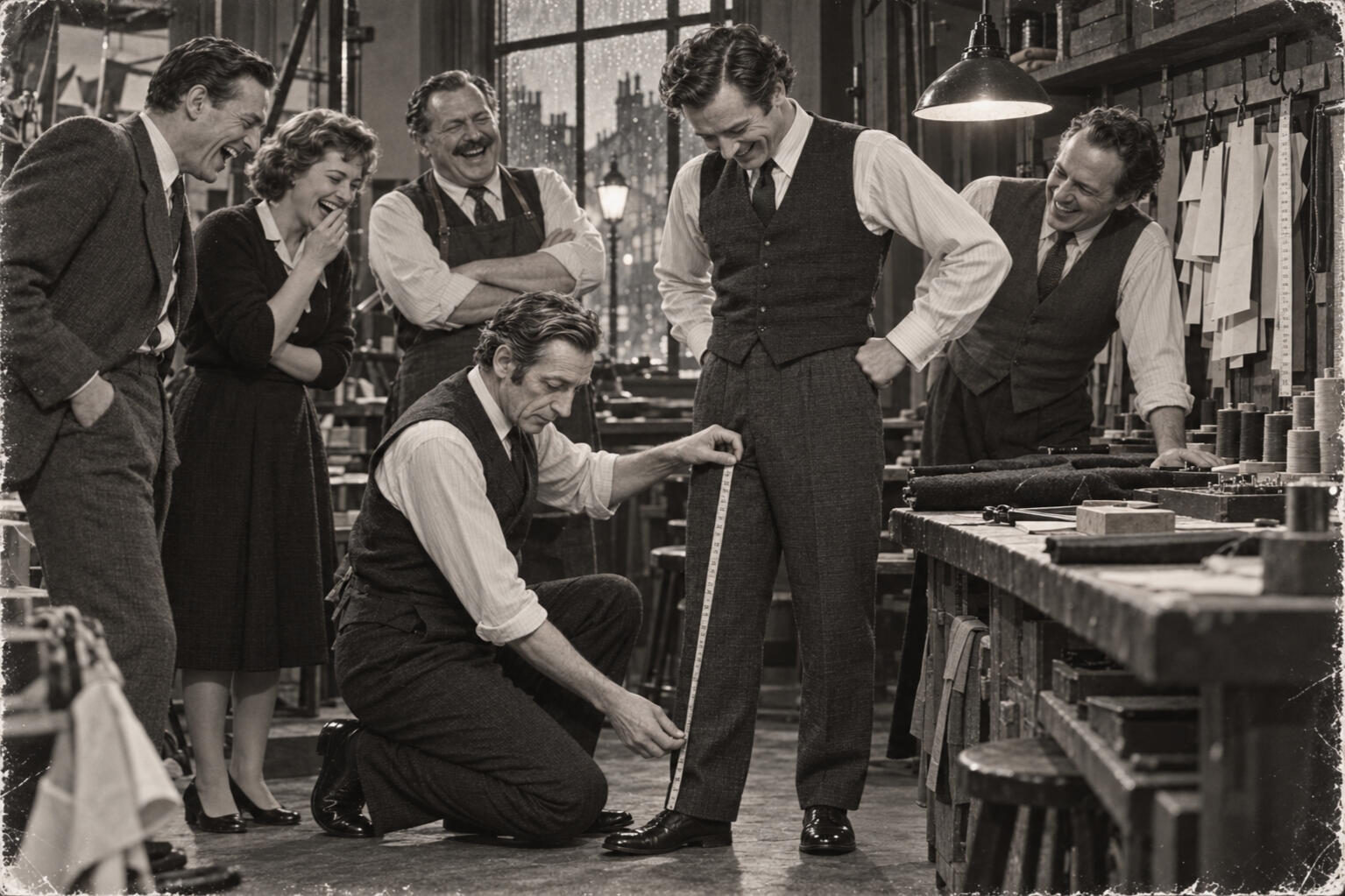
Peter's party trick was that he could guess a man's inside leg measurement by the sound of his voice.He was always willing to demonstrate this but reports said that not all team members were comfortable with it.
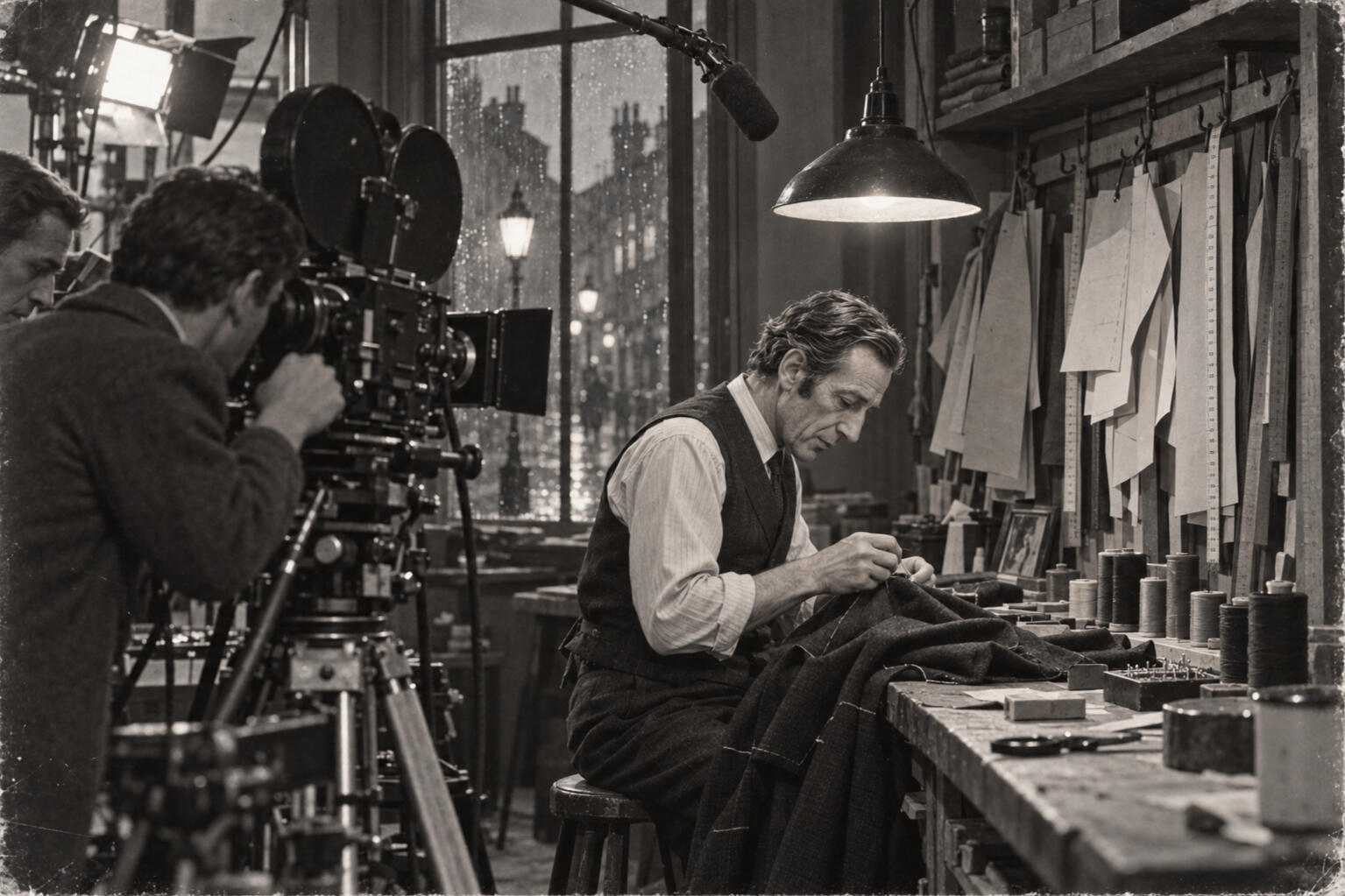
Publicity shot from the archive
The artwork of Reg Baines
The original posters created by Reg Baines are synonymous with the studio and are very much part of its history.They would have been seen throughout the North of England outside cinemas, on hoardings and in places such as train stations.Most of them were damaged in a fire at the studio in late 1966, but we are delighted to now work with Parbold-based artist, Brian Astley.He has faithfully reproduced each poster to a standard that our Reg would have been proud of and each one is available unframed on 240 gsm art paper as a 16 x 20 inch homage to the films we celebrate.